From Jewelry Sample to Bulk Production: A Checklist for Brands


Moving from a jewelry sample to bulk production is an important stage for any brand. The sample may look correct, but production should not begin until the dimensions, materials, stones, plating, logo, quantity and packaging have all been confirmed.
Verbal approval or a general message such as “the sample looks good” can leave important details unclear.
A written jewelry sample to bulk production checklist helps the brand and manufacturer work from the same standard and reduces avoidable misunderstandings.
Why the Approved Sample Matters
A CAD rendering shows the intended design, but it cannot fully represent the finished product.
Casting, polishing, stone setting and electroplating may affect:
Final dimensions
Product weight
Edge definition
Stone appearance
Surface brightness
Plating color
Wearing balance
The physical sample allows the brand to evaluate these details before committing to a larger quantity.
Once approved, the sample should become the main physical reference for bulk production. Photographs, specifications and written change notes should support the sample rather than replace it.
1. Record All Requested Sample Changes
If the first sample requires changes, list them clearly and separately.
Examples include:
Reduce the pendant from 20 mm to 18 mm
Increase the product thickness
Change the chain from 1.0 mm to 1.2 mm
Adjust the main stone color
Move the logo to the back
Use a different clasp
Change from rhodium to 18K gold plating
Add a 5 cm extension chain
Annotated photographs are useful because they show exactly which area needs modification.
Avoid sending changes through several disconnected messages. A numbered list or updated specification sheet makes it easier for the factory to confirm every point.
If a change affects structure, weight or materials, request an updated price before approving production.
Jewelry Sample to Bulk Production Checklist
Before paying the bulk-production deposit, confirm all of the following:
Final product design
Approved physical sample
Dimensions
Approximate weight or weight tolerance
Material
Stone specification
Plating color and thickness
Chain and clasp
Logo and S925 marking
Size or color quantities
Packaging
Quality standard
Production lead time
Shipping method
Payment terms
Each point should be recorded in the order documents or production notes.
2. Confirm Dimensions and Weight
Important dimensions depend on the product type.
For necklaces, check:
Pendant height and width
Pendant thickness
Chain length
Chain width
Extension-chain length
Stone size
For rings, check:
Ring sizes
Band width and thickness
Setting height
Stone dimensions
For earrings, check:
Overall dimensions
Post thickness and length
Earring-back type
Weight per pair
Jewelry production includes manual processes, so small variations may occur. If a measurement or weight is critical, agree on a reasonable tolerance rather than expecting every piece to be mathematically identical.
3. Confirm Material, Stones and Plating
The bulk order should specify the complete material structure.
For example:
925 sterling silver base
Clear 5A CZ
Rhodium plating
Protective e-coating
S925 stamp
For gold-plated jewelry, record:
Gold color
Gold karat
Plating thickness
E-coating requirement
Any physical color reference
For natural stones and pearls, reasonable variations may occur because each material is different. The buyer and factory should agree on acceptable ranges for color, pattern, shape and surface characteristics.
If a particular stone color is essential, approve a physical stone sample or color reference before the full batch is prepared.
4. Confirm the Chain, Clasp and Connecting Parts
Small components strongly influence how a necklace functions.
Before bulk production, confirm:
Chain style
Chain width
Total length
Extension length
Clasp type
Jump-ring size
Tail tag shape
Pendant connection
Metal and plating color of all findings
The chain should be suitable for the pendant weight. Very thin chains may look delicate, but they may not be appropriate for heavier pendants.
Also confirm whether the chain is produced together with the pendant or sourced as a standard component. This may affect color matching, availability and production time.
5. Approve the Logo and Required Markings
The logo should be checked on the physical sample whenever possible.
Confirm:
Logo spelling
Font or artwork
Engraving position
Direction
Size
Depth
S925 stamp position
Very small jewelry pieces may not provide enough space for a large or highly detailed logo. The factory may recommend simplifying the artwork or moving it to a tail tag.
Do not assume the logo will be added automatically. It should appear in the final specification and order confirmation.
6. Provide the Exact Quantity Breakdown
The purchase order should show quantities per design, color and size.
For example:
Variant | Quantity |
Rhodium plated | 30 pieces |
18K gold plated | 30 pieces |
Total | 60 pieces |
For rings, provide the number required for every size. For jewelry using different stones, list the quantity of each stone color separately.
This prevents the factory from assuming that the total quantity should be divided equally.
If additional replacement pieces or production overages are required, confirm this before production begins.
7. Confirm Packaging Before Production Is Finished
Packaging should be decided early, especially when custom printing is required.
Confirm whether the order uses:
Simple individual protective bags
Anti-tarnish bags
Branded pouches
Jewelry cards
Custom boxes
Care cards
Barcode labels
Product stickers
Custom packaging may have a longer production time than the jewelry. It may also require its own sample approval and MOQ.
If the buyer will use a separate packaging supplier, confirm whether the jewelry factory should send the products loose, individually bagged or packed according to specific instructions.
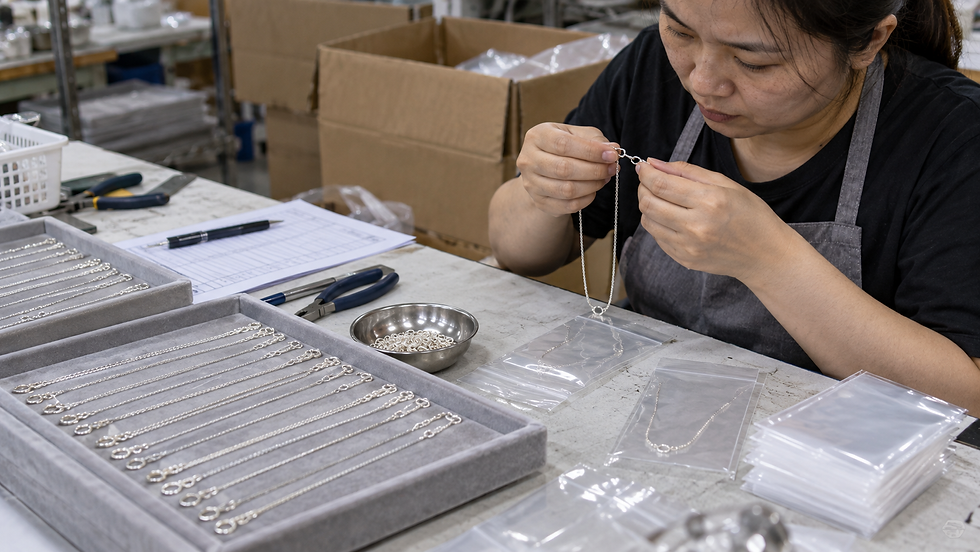
8. Agree on Quality-Control Standards
The manufacturer should know which details are most important to the brand.
Inspection may include:
General appearance
Important measurements
Stone security and alignment
Polishing
Soldering
Plating color and coverage
Clasp function
Chain condition
Logo and markings
Quantity and variants
Packaging
The approved sample should be the primary reference, together with the written specification.
For a more detailed inspection guide, read our article about sterling silver jewelry quality control.
9. Confirm the Production Timeline
Ask the manufacturer when the lead time begins.
It may begin after:
The deposit is received
The sample is approved
The final specifications are confirmed
Materials are available
Packaging artwork is approved
Production time and shipping time should be listed separately.
Possible delays may be caused by:
Sample modifications
Custom stone production
Thick or special plating
Custom packaging
Third-party testing
Peak production periods
Changes requested after production begins
A realistic schedule should include time for final inspection and corrections before shipment.
10. Confirm Payment and Shipping Terms
Before production, both sides should agree on:
Deposit amount
Balance-payment timing
Payment method
Currency
Bank or platform charges
Shipping method
Trade term
Delivery address
Customs responsibility
Possible shipping terms include EXW, FOB, DAP or DDP. The most suitable option depends on the destination and whether the buyer has its own freight forwarder.
The buyer should understand whether duties and taxes are included before comparing different shipping quotations.

What Should Happen If the Bulk Order Differs From the Sample?
Discuss the issue-resolution process before production whenever possible.
If a problem occurs, the first step is to identify:
How many pieces are affected
Whether the problem is functional or cosmetic
Whether it can be corrected
Whether it falls outside the agreed tolerance
Whether it differs from the approved sample
Whether replacement or reworking is appropriate
Clear photographs, inspection results and order specifications help both sides evaluate the problem objectively.
Quality expectations should be realistic. Handmade and semi-handmade jewelry can have small variations, but functional faults, missing stones, open rings or incorrect specifications should be separated and corrected.
Final Approval Checklist
Before authorizing bulk production, confirm:
The physical sample is approved.
All changes are recorded in writing.
The final unit price is confirmed.
Dimensions and tolerances are confirmed.
Material and stone specifications are confirmed.
Plating color and thickness are confirmed.
Chain, clasp and connecting parts are confirmed.
Logo and S925 markings are approved.
The quantity breakdown is correct.
Packaging requirements are complete.
Production and shipping times are understood.
Payment and trade terms are recorded.
Do not approve production while major details remain undecided.
Final Recommendation
A successful transition from jewelry sample to bulk production depends on clear written specifications and a carefully approved physical sample.
Brands should not rely only on renderings, photographs or scattered messages. One final specification sheet, one approved sample and one confirmed quantity breakdown provide a much stronger production standard.
Dciya Jewelry supports CAD development, prototype sampling, small trial orders and bulk manufacturing for sterling silver jewelry brands. You can review our OEM/ODM jewelry manufacturing services or contact our factory to discuss a new collection.


Comments